
Industrial facilities are some of the most complex environments to manage and expand. Whether it’s a manufacturing plant, warehouse, power station, or processing facility, ensuring smooth operations while planning for growth requires highly accurate, up-to-date data. However, relying on outdated blueprints or manual measurements can lead to costly errors, inefficiencies, and safety risks.
This is where laser scanning technology has become a game-changer. By capturing precise 3D data of industrial sites, laser scanning supports facility management, maintenance, and expansion planning with unparalleled accuracy and efficiency.
At Platinum 3D Consultants, we specialise in measuring and modelling industrial environments, creating BIM-ready Revit models and geo-referenced point clouds that provide actionable insights for facility managers, engineers, and project teams.
This blog explores why laser scanning is essential for industrial facility management and expansion, detailing the key benefits, applications, and real-world advantages of using this cutting-edge technology.

Challenges in Managing and Expanding Industrial Facilities
Industrial facilities are complex, often featuring intricate machinery, large-scale production lines, and extensive MEP (mechanical, electrical, and plumbing) systems. Managing these facilities presents several challenges:
1. Outdated or Inaccurate Documentation
Many industrial plants have incomplete or outdated records of their infrastructure. Modifications over the years—such as machinery relocations or new system installations—are rarely documented accurately, making it difficult to plan expansions or upgrades.
2. Complex Spatial Constraints
Industrial environments often have tightly packed equipment, overhead piping, and multiple levels. Conducting manual measurements in these conditions is not only time-consuming but also prone to errors.
3. Safety and Accessibility Issues
Traditional surveying methods require manual access to all areas of a site, including hazardous zones, confined spaces, and elevated structures. This poses significant health and safety risks to survey teams.
4. Risk of Costly Mistakes in Expansion Projects
Expanding an industrial facility without accurate spatial data can lead to misaligned installations, project delays, and costly rework. Ensuring that new structures, systems, and machinery integrate seamlessly with existing infrastructure is critical.
How Laser Scanning Overcomes These Challenges
Laser scanning, also known as LiDAR (Light Detection and Ranging), provides a fast, non-intrusive, and highly precise method of capturing industrial facilities in their current state. The result is a highly detailed 3D digital twin of the site, allowing for more effective management and expansion planning.
1. Capturing Highly Accurate 3D Data
Laser scanning technology collects millions of data points per second, creating a dense point cloud that represents every structure, component, and piece of equipment within a facility.
What This Means for Facility Managers:
- A complete and true-to-life digital record of the facility.
- Eliminates the risk of working with inaccurate or outdated drawings.
- Precise measurements for maintenance, retrofitting, and expansions.
2. Streamlining Expansion and Retrofit Planning
Expanding an industrial site requires seamless integration between new and existing infrastructure. Laser scanning ensures that any additions—such as new buildings, production lines, or mechanical systems—are planned with millimetre precision.
How It Helps Expansion Projects:
- Provides an accurate spatial reference for design teams.
- Ensures proper fitment of new equipment within existing layouts.
- Minimises the risk of design clashes and costly modifications.
3. Enhancing Facility Maintenance and Asset Management
Laser scanning doesn’t just support new projects—it also optimises ongoing facility management. By creating a BIM-ready Revit model, facility managers gain a comprehensive, real-time visualisation of all assets, including:
✔ Structural elements (walls, floors, ceilings).
✔ MEP systems (pipes, ducts, cabling).
✔ Machinery and production lines.
How It Helps Facility Maintenance:
- Reduces the need for manual inspections and site visits.
- Helps track wear and tear on critical components.
- Supports preventative maintenance scheduling.
4. Improving Health and Safety Compliance
Industrial sites have stringent health and safety regulations, and laser scanning plays a crucial role in ensuring compliance.
Key Benefits for Safety Planning:
- Identifies hazardous areas and restricted zones.
- Aids in designing safe access routes for personnel and equipment.
- Provides fire safety teams with accurate evacuation plans.
5. Reducing Downtime and Project Delays
Unlike traditional surveying methods, laser scanning is fast, efficient, and non-intrusive, meaning minimal disruption to ongoing industrial operations.
How It Saves Time and Costs:
- Reduces the need for multiple site visits.
- Enables remote project collaboration, reducing on-site personnel requirements.
- Allows for accurate prefabrication of components, reducing delays on-site.
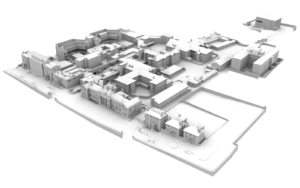
Real-World Applications of Laser Scanning in Industrial Facility Management
Case Study: Upgrading a Manufacturing Plant with Minimal Downtime
A client operating a large-scale manufacturing plant required a facility-wide upgrade of its HVAC and electrical systems. However, the plant operated 24/7, meaning any disruptions could result in significant financial losses.
✔ Platinum 3D Consultants performed a laser scan survey, capturing precise data on existing MEP systems.
✔ We created a BIM-ready model to help engineers design the new systems off-site.
✔ This enabled prefabrication and seamless installation, reducing plant downtime by 30%.
The Platinum 3D Consultants Advantage
At Platinum 3D Consultants, we offer state-of-the-art laser scanning and measured building survey services tailored to industrial facility management and expansion. Our solutions include:
✔ High-Precision Laser Scanning – Capturing ultra-accurate 3D data of industrial sites.
✔ Scan to BIM Services – Creating detailed Revit models for planning and facility management.
✔ Measured Surveys for MEP – Documenting complex mechanical, electrical, and plumbing systems.
✔ Geo-Referenced Digital Twins – Providing interactive 3D models for real-time facility oversight.
We work with industrial plants, warehouses, power stations, and processing facilities to help streamline expansion projects, maintenance planning, and regulatory compliance.
Talk To Platinum 3D Consultants
Laser scanning is no longer an optional tool—it is an essential technology for industrial facility management and expansion. From accurate as-built documentation to seamless integration of new infrastructure, it reduces risk, improves efficiency, and minimises downtime.
At Platinum 3D Consultants, we provide cutting-edge laser scanning and BIM solutions to help industrial facility managers make data-driven decisions with confidence.
Contact us today to learn how our laser scanning expertise can transform your industrial site management and expansion plans. 🚀🏭