
Preserving heritage buildings is both a privilege and a challenge. These architectural treasures offer a glimpse into the past, showcasing craftsmanship and historical significance. However, their preservation requires balancing meticulous care with modern demands. Traditional methods of surveying and documenting these buildings often fall short when it comes to accuracy and non-intrusive techniques.
This is where laser scanning comes into its own, offering an innovative, precise, and non-invasive solution for preserving heritage buildings. At Platinum 3D Consultants, we specialise in using cutting-edge laser scanning and Scan to BIM technology to create accurate digital models of heritage structures. These models serve as invaluable tools for restoration, conservation, and future planning, ensuring these landmarks endure for generations to come.

The Challenges of Preserving Heritage Buildings
Heritage buildings present unique challenges due to their age, complexity, and historical value. Common issues include:
- Fragile Structures
Many heritage buildings are built with materials that have become fragile over time. Traditional surveying methods may risk further damage to the structure. - Complex Architectural Features
Heritage buildings often include intricate details such as carvings, mouldings, and ornate facades that are difficult to measure and document accurately. - Limited or Outdated Documentation
Historical records, if they exist, may not reflect the current condition of the building after years of wear, modifications, or environmental impact. - Compliance with Preservation Standards
Conservation efforts must adhere to strict guidelines, requiring accurate and detailed data to support planning and decision-making. - Balancing Modernisation with Preservation
Incorporating modern systems, such as HVAC or electrical upgrades, into heritage buildings without disrupting their historical integrity is a delicate process that requires precise planning.
How Laser Scanning Solves These Challenges
Laser scanning of heritage buildings has revolutionised the way we document and preserve heritage buildings. Here’s how it works and why it’s ideal for these delicate projects.
1. Non-Invasive and Accurate Data Collection
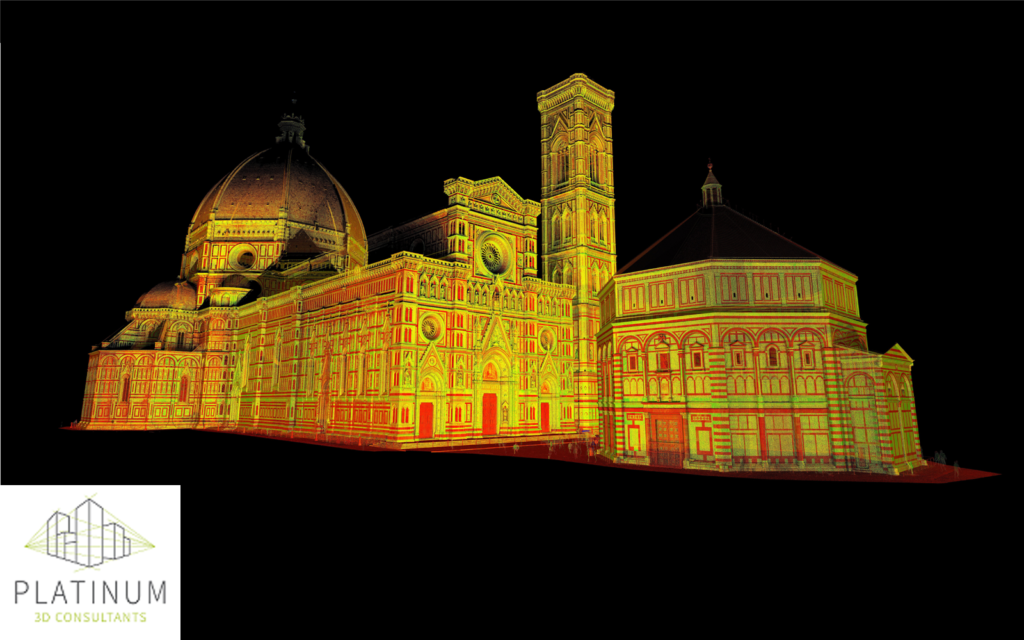
Laser scanning captures millions of data points per second, creating a point cloud that represents the building’s geometry with millimetre precision. The process is non-invasive, meaning no physical contact with the structure is required.
- Platinum 3D’s Expertise:
Our team uses advanced laser scanners to survey heritage buildings without disturbing their fragile materials or intricate details. This ensures that every element, from grand facades to hidden structural components, is captured accurately. - Benefits:
- Minimises the risk of damage during surveys.
- Provides a complete and highly detailed record of the building.
2. Detailed Digital Twins for Preservation
The data captured by laser scanning is processed into 3D digital models, also known as digital twins. These models serve as a virtual representation of the building, including all architectural and structural features.
- Platinum 3D’s Approach:
Using Scan to BIM technology, we convert point cloud data into BIM-ready Revit models. These models include intricate details, enabling architects and conservationists to visualise the building’s condition and plan restoration efforts with precision. - Benefits:
- Facilitates comprehensive planning for repairs or upgrades.
- Serves as a long-term digital archive for future reference.
3. Documentation of Intricate Details
Heritage buildings often feature complex architectural details that are challenging to document using traditional methods. Laser scanning captures these features with unparalleled accuracy, preserving their design for future generations.
- Platinum 3D’s Expertise:
We ensure that even the most intricate carvings and mouldings are documented in the 3D model, supporting detailed restoration work. - Benefits:
- Allows for accurate replication of features during restoration.
- Creates a digital record of designs that may otherwise deteriorate over time.
4. Supporting Modernisation Efforts
Laser scanning enables the integration of modern systems, such as electrical, plumbing, or climate control, into heritage buildings without compromising their historical integrity. By identifying potential clashes between new installations and existing structures, laser scanning facilitates seamless upgrades.
- Platinum 3D’s Services:
Our geo-referenced models align with real-world coordinates, ensuring that modern interventions fit perfectly within the building’s unique geometry. - Benefits:
- Supports sustainable retrofitting with minimal disruption.
- Ensures compliance with preservation standards during upgrades.
5. Monitoring Structural Health
Heritage buildings are vulnerable to environmental factors such as weather, pollution, and natural wear. Laser scanning can track changes in the structure over time, helping conservation teams monitor and address issues before they escalate.
- Platinum 3D’s Approach:
We provide baseline models that can be compared with future scans to detect shifts, cracks, or deterioration. - Benefits:
- Enables proactive maintenance to extend the building’s lifespan.
- Provides a reliable tool for assessing structural integrity.
Case Studies: Real-World Applications
Historic Cathedral Restoration
A client needed to document a historic cathedral for restoration planning. Using laser scanning, we captured the cathedral’s intricate stonework, stained glass windows, and vaulted ceilings with millimetre precision. The resulting BIM model allowed the design team to plan repairs while maintaining the building’s historical accuracy.
18th-Century Manor House Conservation
For an 18th-century manor house, we created a detailed 3D model that included structural elements and ornate interiors. This model supported the integration of a modern heating system without altering the building’s historical features.
Unique Benefits of Laser Scanning for Heritage Buildings
- Unmatched Accuracy
Laser scanning captures every detail with precision, ensuring that restoration plans align perfectly with the building’s existing structure. - Time and Cost Efficiency
By eliminating the need for manual measurements, laser scanning accelerates the survey process and reduces project costs. - Enhanced Collaboration
Digital models allow architects, engineers, and conservationists to collaborate effectively, working from the same accurate data. - Future-Proofing
Digital twins provide a long-term record of the building, supporting ongoing maintenance and future renovations. - Sustainability
By enabling precise planning and efficient resource use, laser scanning contributes to sustainable preservation practices.
Why Choose Platinum 3D Consultants?
At Platinum 3D Consultants, we combine advanced technology with deep expertise to support the preservation of heritage buildings. Our services include:
- Laser Scanning: Capturing precise data for fragile and complex structures.
- Scan to BIM: Creating detailed Revit models tailored to restoration and conservation needs.
- Measured Building Surveys: Providing comprehensive documentation for heritage projects.
- Geo-Referenced Models: Ensuring spatial accuracy for seamless planning and execution.
With years of experience and a commitment to excellence, we deliver solutions that protect the past while preparing buildings for the future.
Talk To Platinum 3D Consultants
Preserving heritage buildings is a delicate process that demands precision, care, and advanced technology. Laser scanning of buildings and environments offers an unmatched ability to document, analyse, and restore these architectural treasures, ensuring their longevity and historical integrity. At Platinum 3D Consultants, we’re proud to play a role in safeguarding heritage sites, using our expertise to create detailed digital models that support conservation efforts worldwide.
Contact us today to learn how our laser scanning services can help preserve your heritage building. Together, we can protect history for future generations.