
Heritage and complex refurbishment projects carry layers of historical value and architectural significance. Managing such projects effectively requires precision, care, and comprehensive documentation. At Platinum 3D Consultants, our laser scanning services—combined with BIM-ready Revit modelling—offer exceptional value for stakeholders navigating the delicate balance between preservation and innovation.
Why Heritage Needs Precision
Historical buildings often feature intricate craftsmanship, irregular geometries, and fragile materials. Traditional survey methods can be slow, labour-intensive, and prone to inaccuracies, and they may involve physical contact that risks damage. Even the most experienced surveyors can struggle to capture the subtle curves of vaulted ceilings, the warping of century-old timber, or the fine details of carved stonework using manual methods alone.
3D laser scanning provides a non-invasive, contact-free way to record every detail with millimetre accuracy. This approach ensures the building’s unique features are preserved digitally without any physical interference, giving conservation architects and project teams the exact information they need while protecting the site itself.
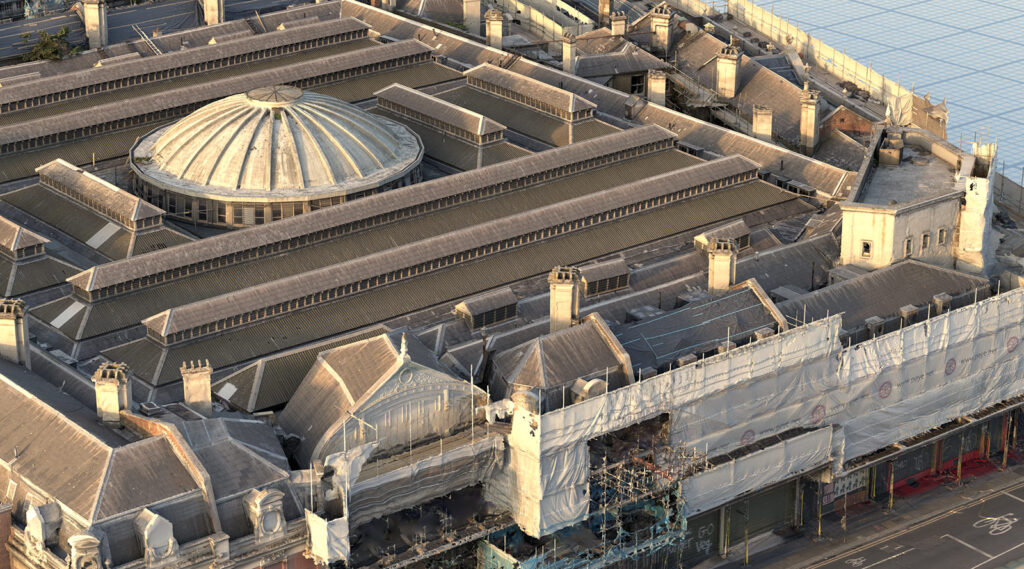
Capturing the True Geometry of Time-Worn Structures
Time can leave its mark in ways that are almost invisible until you look closely. Structural settling, material shrinkage, and past repairs often leave a building slightly out of square, with hidden misalignments. Laser scanning generates dense point clouds that capture these subtle deviations with incredible accuracy, from the largest structural spans to the smallest decorative flourishes.
This rich, spatially accurate data forms a precise digital twin of the existing structure. Architects, engineers, and planners can then work with confidence, knowing that their designs are based on the true, as-built geometry—not assumptions or legacy drawings that may be decades out of date. In heritage contexts, this fidelity to reality is essential, as even the smallest error can have a significant impact on authenticity and structural integrity.
Supporting Conservation and Informed Decision-Making
Successful heritage conservation requires balancing modern functionality with historical integrity. Having accurate, verifiable data means design proposals can be assessed against the existing fabric in detail. Architects can ensure that any alterations are sympathetic to the original style, planners can approve work based on factual evidence, and conservation officers can be confident that the project will respect the site’s character.
This level of documentation is also essential for meeting planning conditions, applying for funding, and providing proof of compliance with regulations such as those set out by Historic England or local heritage authorities. For developers and estate managers, it creates a robust, lasting record that can be referenced for decades to come.
Faster Documentation with Minimal Disruption
Working on historic buildings often comes with access restrictions, sensitive environments, or active public use. Prolonged site visits can be disruptive, costly, and even risky for fragile structures. Laser scanning dramatically reduces the amount of time needed on site by capturing comprehensive measurements and visual data in a single, efficient pass.
In many cases, a complete scan can be conducted in hours rather than days. This not only keeps projects on schedule but also reduces physical impact on the building—an important consideration when working with delicate materials or in occupied heritage spaces.
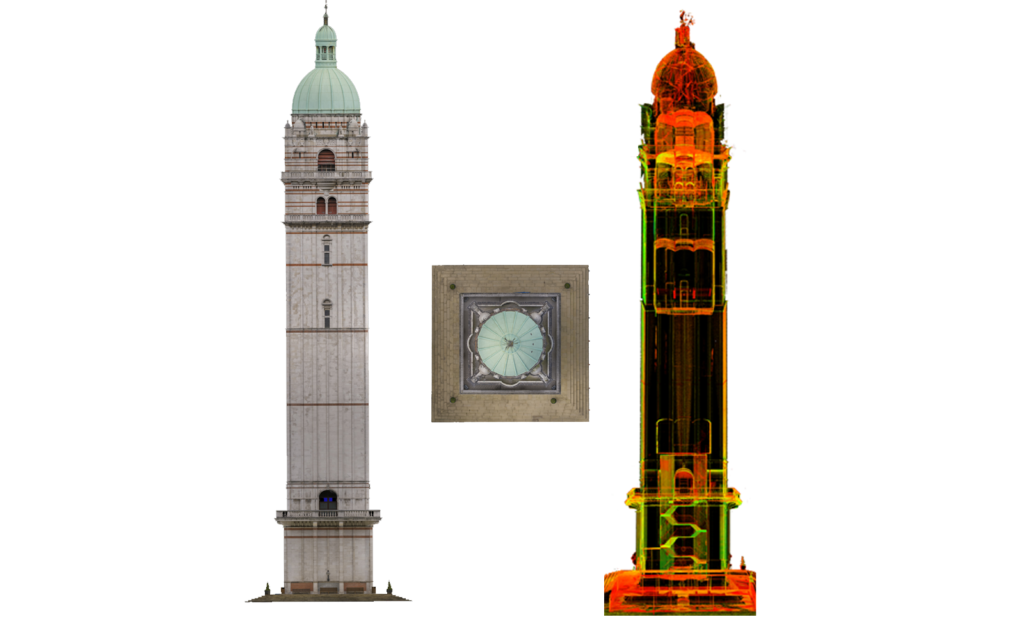
From Scan to Model – Enabling BIM in Heritage Contexts
While point clouds provide exceptional measurement data, their full value is realised when transformed into BIM-ready Revit models. At Platinum 3D, we typically produce LOD3 models for heritage projects, incorporating parametric elements for walls, beams, windows, decorative mouldings, and other architectural features.
These geometrically accurate models allow design teams to simulate interventions, run clash detection, and plan construction phases with a clear understanding of how every detail interacts. For heritage work, this means being able to integrate new systems—such as heating, lighting, or accessibility improvements—without compromising protected features.
Engaging Stakeholders through Visual Context
Not every stakeholder will work directly with BIM data, but most will want to understand the space. This is where our Matterport virtual tours add further value. These immersive, photorealistic walkthroughs enable heritage committees, funding bodies, planners, and the public to experience the building remotely.
By providing both the technical accuracy of a BIM model and the visual accessibility of a virtual tour, Platinum 3D ensures everyone is working from the same understanding, which helps to secure buy-in and support for complex proposals.
Long-Term Stewardship Through Digital Heritage Assets
The benefits of high-accuracy surveys extend well beyond the immediate project. Digital survey data and BIM models become permanent resources for long-term maintenance, monitoring, and management. Estate teams and facilities managers can track changes over time, plan preventative maintenance, and document interventions for future reference.
This digital preservation also offers a safeguard against unexpected events. In the unfortunate event of damage from fire, flooding, or structural failure, the scanned record provides an invaluable reference for restoration efforts.
Platinum 3D’s Role in Heritage and Complex Refurbishment Projects
Our experience in delivering survey-grade laser scanning and BIM modelling for heritage and complex refurbishment schemes means we understand the specialist requirements of these projects. We combine technical expertise with a deep respect for the historical significance of each building, ensuring that our work supports both its preservation and its future use.
By creating an accurate, detailed, and accessible record of heritage assets, we enable stakeholders to make informed, confident decisions at every stage. This approach ensures that the character and value of historic properties are not only retained but celebrated as they are adapted for the future.
Preserving the Past While Planning for the Future
Heritage projects require both sensitivity and precision. By bringing together laser scanning, BIM modelling, and visual engagement tools, Platinum 3D Consultants bridges the gap between history and modern design. The result is a process that respects architectural legacy while delivering the clarity and accuracy needed to plan with confidence.
Ready to protect the character of your heritage project while planning with absolute accuracy? Contact Platinum 3D Consultants today to discuss how our laser scanning and BIM modelling services can support your restoration or refurbishment from start to finish.